F
Species Profile

Frilled Lizard

Chlamydosaurus kingii

Pop the frill, own the moment
Matt Cornish/Shutterstock.com

Frilled Lizard Distribution

Click a location to explore more animals from that region

Loading map...
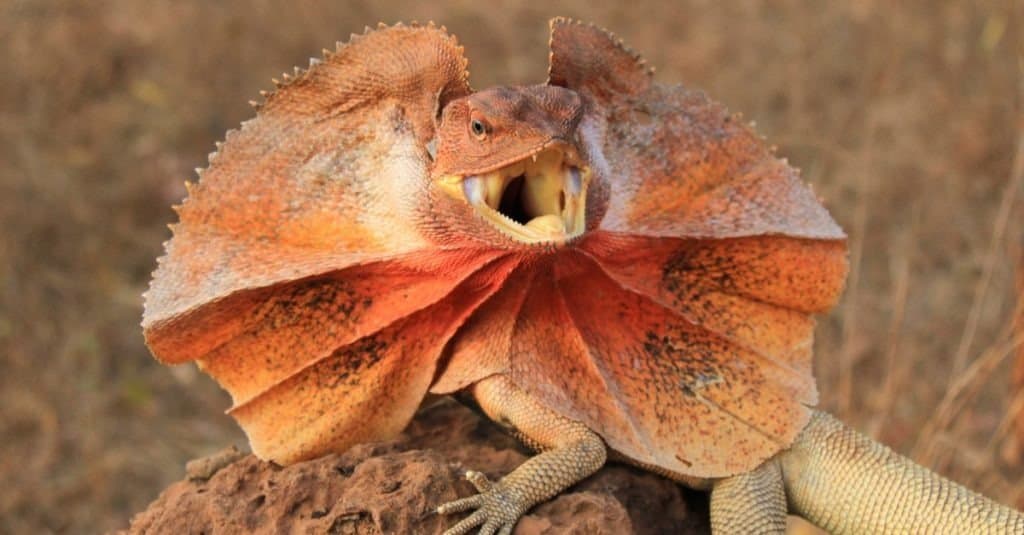
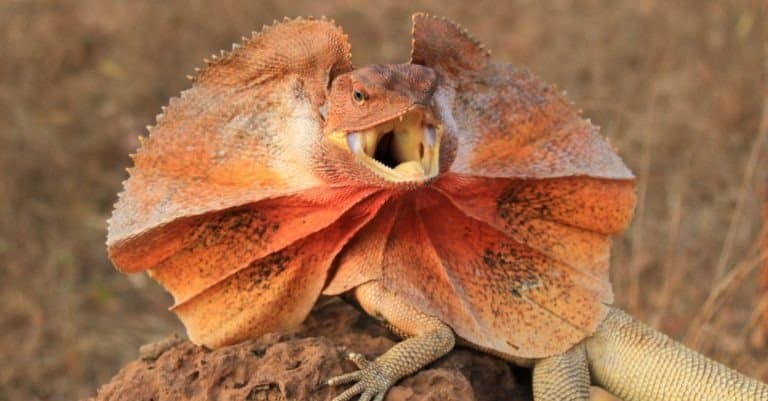
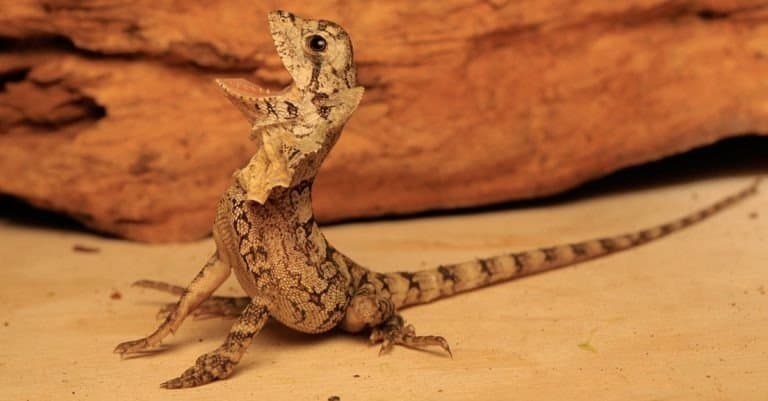
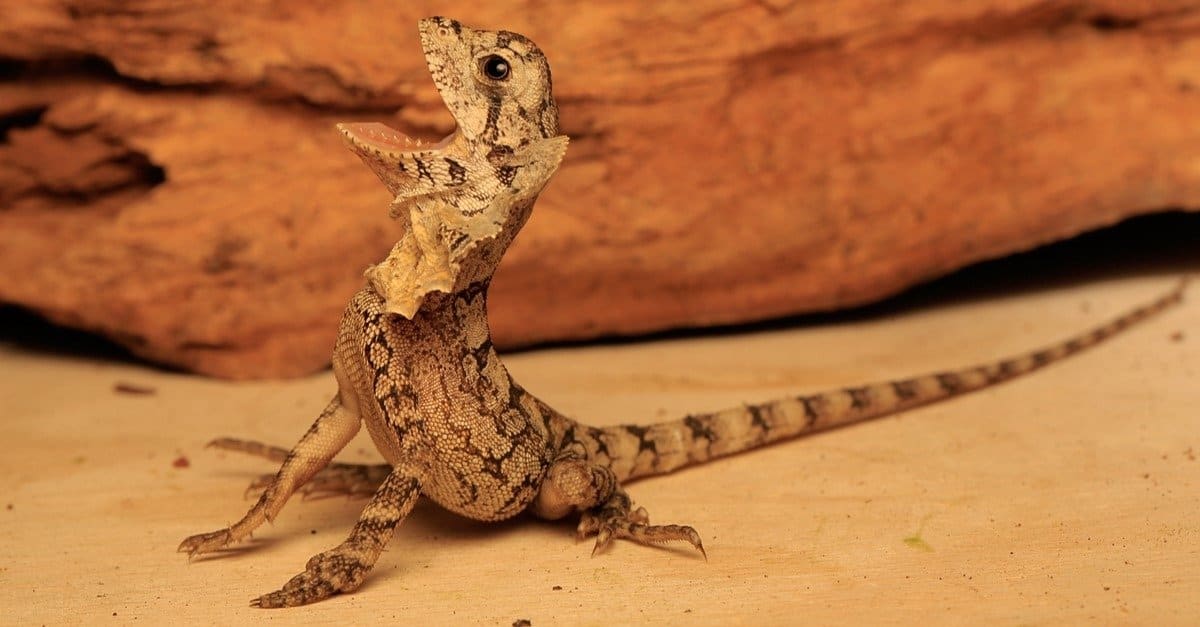
Frilled Lizard (Chlamydosaurus kingii) on termite mound

At a Glance

Wild Species
Also Known As Frill-necked lizard, Frilled-neck lizard, Frill-neck lizard, Frill-necked dragon, Frilled dragon, Frilly lizard
Activity Diurnal
Lifespan 6 years
Weight 0.9 lbs
Status Least Concern
Did You Know?

Adult total length commonly ~60-85 cm (max reported ~90 cm), with a snout-vent length around ~25-30 cm (field guides; e.g., Cogger, 2014).

Scientific Classification

A large agamid lizard native to northern Australia and southern New Guinea, famous for its expandable neck frill used in threat displays.

Kingdom
Animalia
Phylum
Chordata
Class
Reptilia
Order
Squamata
Family
Agamidae
Genus
Chlamydosaurus
Species
kingii

Distinguishing Features

  • Large circular neck frill that can be rapidly erected when threatened
  • Bipedal sprinting when escaping predators
  • Typically brown/grey with mottled camouflage; frill often has orange/red/yellow tones
  • Arboreal posture on tree trunks; relies on display (frill + open mouth) to deter predators

Physical Measurements

Males and females differ in size

Length
♂ 2 ft 8 in (2 ft 4 in – 3 ft)
♀ 1 ft 12 in (1 ft 6 in – 2 ft 4 in)
Weight
♂ 2 lbs (1 lbs – 2 lbs)
♀ 1 lbs (0 lbs – 1 lbs)
Tail Length
♂ 1 ft 11 in (1 ft 8 in – 2 ft 2 in)
♀ 1 ft 3 in (11 in – 1 ft 7 in)
Top Speed
9 mph
About 3-4 m/s

Appearance

Primary Colors
Secondary Colors
Skin Type Dry, hard overlapping scales: body scales small and bumpy to slightly ridged; head with larger plate-like scales. Frill is a fold of skin on long hyoid cartilage spines, usually folded against the neck.
Distinctive Features
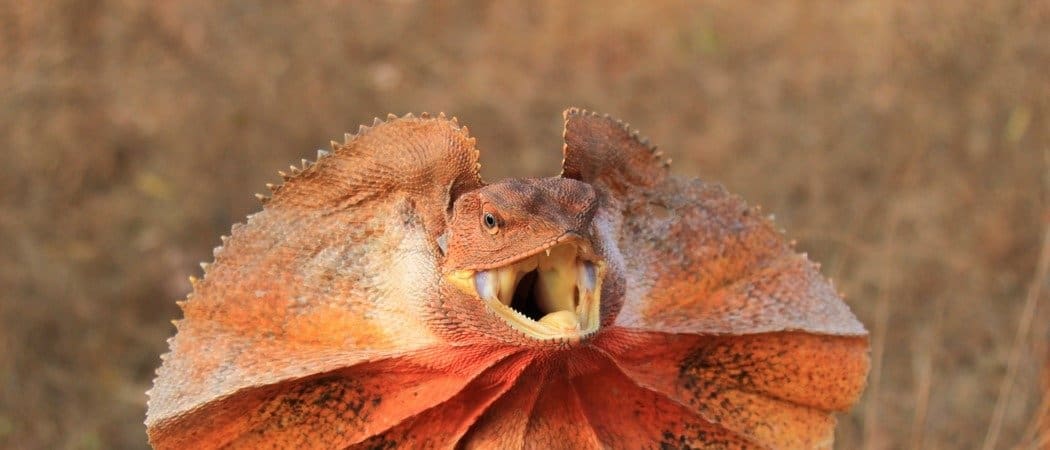
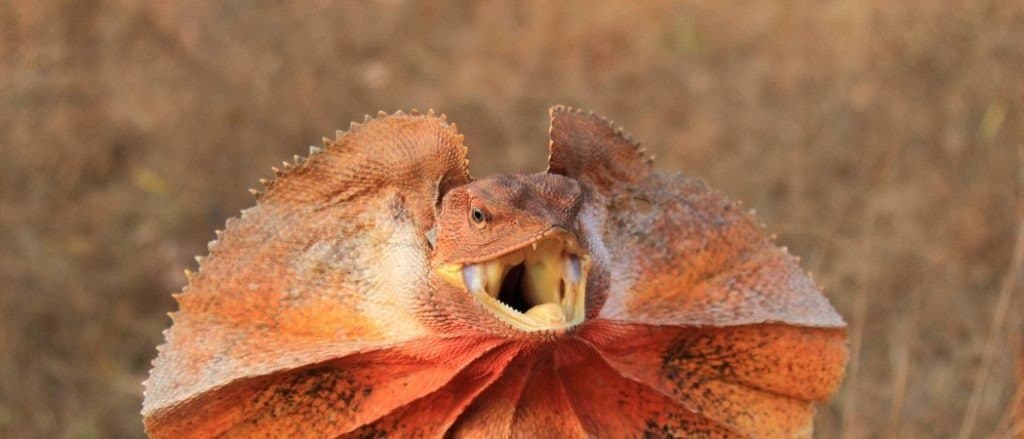
  • Expandable circular neck frill: usually folded back along the neck and shoulders, it quickly opens when threatened or during social displays by extending hyoid-supported struts, framing the head and making the lizard look much bigger.
  • Threat display behavior tightly linked to appearance: frill erection + open-mouth gaping (often showing brightly colored oral lining) + hissing; may be accompanied by body elevation and lateral presentation to maximize silhouette.
  • Arboreal lifestyle: commonly perches on tree trunks/branches; cryptic mottled brown-tan coloration and flattened posture aid concealment against bark.
  • Bipedal running: when fleeing on the ground it can sprint upright on hind limbs with forelimbs held up, enhancing speed and maneuverability between trees.
  • Large agamid proportions: commonly reported total length up to ~0.9 m (tail comprising a substantial fraction of total length); adult snout-vent length typically ~0.23-0.27 m in many references, with long, tapering tail.
  • Head and jaws: triangular head with robust jaws; gaping display exposes the mouth interior for visual signaling in addition to the frill.
  • Distribution-linked variation: frill and body coloration/patterning can vary across northern Australia and southern New Guinea populations (e.g., differing degrees of orange/red/yellow in the frill and throat).
  • Longevity (reported): captivity records commonly cited around ~10 years (sometimes longer with excellent husbandry); wild lifespan is less precisely documented and is typically lower due to predation and environmental pressures.

Sexual Dimorphism

Sexual dimorphism is present: males are generally larger and have more prominent display morphology (notably frill size and head/jaw robustness), consistent with a strong role for visual signaling in male-male competition and courtship displays.

♂
  • Larger average body size and more robust head/jaws; tends to present a more imposing silhouette when the frill is erected.
  • Frill often proportionally larger and more visually prominent; display contrast (dark rib lines vs lighter/orange-red membranes) can appear stronger in many males.
  • More assertive/ frequent display use in territorial or courtship contexts (frill erection + gaping/hissing), leveraging their larger apparent size.
♀
  • Typically smaller and less robust than males, with a proportionally less imposing display profile when the frill is erected.
  • Frill present and functional but often less expansive/less visually emphasized than in males; coloration may appear more subdued in many individuals.

Did You Know?

Adult total length commonly ~60-85 cm (max reported ~90 cm), with a snout-vent length around ~25-30 cm (field guides; e.g., Cogger, 2014).

Its frill is folded like a cape most of the time; in a threat display it snaps open via hyoid (throat) bones, making the head look much larger (behavioral descriptions in classic natural history accounts; e.g., Pianka & Vitt, 2003).

When startled, it often runs upright on the hind legs for short bursts-especially between trees-then climbs to perch on trunks (Pianka & Vitt, 2003).

Typical diet is heavily insect-based (ants, beetles, termites), but it may take other invertebrates and small vertebrates when available (regional diet summaries; e.g., Cogger, 2014).

Reproduction is oviparous; reported clutch sizes are commonly in the range of ~8-23 eggs (varies by locality/condition; summarized in Australian reptile references such as Cogger, 2014).

In captivity, lifespans of roughly a decade or more are reported (often ~10-15 years with good care in zoo/husbandry records), though wild longevity is harder to document precisely.

The species is listed as Least Concern (IUCN), reflecting its wide distribution across northern Australia and parts of southern New Guinea.

Unique Adaptations

  • Expandable neck frill: a large, collapsible membrane supported by elongated cartilage/bony elements connected to the hyoid apparatus-dramatically increases apparent size in an instant.
  • Display-first defense: relies on intimidation (visual + auditory cues) to prevent a chase or fight, reducing injury risk compared with direct combat.
  • Locomotor flexibility: strong hind limbs enable short bipedal dashes, while long claws and limb posture support fast vertical climbing on rough-barked trees.
  • Camouflage-at-rest: when the frill is folded and the body is pressed to bark, its mottled browns/greys blend with trunks in open woodland.
  • Seasonal lifestyle fit: behavior and habitat use are well-suited to monsoonal north Australia-using trees for refuge in open savanna where ground cover can be sparse.

Interesting Behaviors

  • Threat display sequence: body raised, mouth gaping, frill fully erected, often accompanied by hissing; may include lunging or short charges before retreating to a tree.
  • Arboreal vigilance: commonly perches on tree trunks (often head-up), scanning for predators and prey; uses rapid climbing as the primary escape strategy.
  • Bipedal sprinting: when fleeing across open ground, it may run on hind limbs with the tail acting as a counterbalance, then quickly transitions back to climbing.
  • Intraspecific signaling: frill erection and head/body posturing are also used in social interactions (e.g., spacing, dominance, and mate-related displays), not only against predators.
  • Thermoregulation by posture: adjusts body angle and exposure on trunks/branches to manage heat load in hot, seasonal savanna climates.

Cultural Significance

The frilled lizard (Chlamydosaurus kingii) is a well-known Australian reptile used in wildlife education, tourism, and media as a symbol of the Top End. Its frill display inspired pop-culture dinosaurs like Dilophosaurus and became a global symbol of a big reptile threat display.

Myths & Legends

In Australian bush tales and campfire stories, the frilled lizard (Chlamydosaurus kingii) is called a tiny 'dragon' that opens a shield-like frill to scare bigger animals, inspired by its real display.

Early colonial naturalists told dramatic stories about the frill opening. The scientific name Chlamydosaurus, meaning 'cloaked lizard', led to tales of a reptile that 'wears a cape' when scared.

Film and media legend says the frilled lizard (Chlamydosaurus kingii) inspired movie dinosaurs — seen as a 'living model' showing how a small theropod might try to look bigger to scare enemies.

Conservation Status

LC Least Concern

Widespread and abundant in the wild.

Population Stable

Protected Under

  • Australia: Environment Protection and Biodiversity Conservation (EPBC) Act 1999 (native wildlife protections; international trade/export controls)
  • Australia: Protected as native fauna under relevant State/Territory wildlife legislation within its range (e.g., Queensland Nature Conservation Act 1992; Northern Territory Territory Parks and Wildlife Conservation Act 1976)
  • Occurs in multiple protected areas/reserves across northern Australia, providing partial habitat security

Life Cycle

Birth 12 hatchlings
Lifespan 6 years

Lifespan

In the Wild
3–10 years
In Captivity
8–15 years

Reproduction

Mating System Polygyny
Social Structure Solitary
Breeding Pattern Transient
Fertilization Internal Fertilization
Birth Type Internal_fertilization

Frilled lizards (Chlamydosaurus kingii) are mostly solitary. Males use frills and displays to defend territories and mate with several females (behavioral polygyny). Females lay about 8–23 eggs after internal fertilization and do not care for young.

Behavior & Ecology

Social None (typically solitary) Group: 1
Activity Diurnal
Diet Insectivore Termites and ants
Seasonal Hibernates

Temperament

Generally wary and avoidant; relies on crypsis and stillness when approached
Flight-first strategy (rapid escape to trees); may run bipedally on the ground during escape
When escape is blocked, can become intensely defensive-escalating to full frill display and lunging bluff
Adult males more prone to territorial aggression toward other males during breeding season; females typically less combative

Communication

generally silent; may produce an audible hiss/exhalation during high-intensity defensive displays Not a complex vocal repertoire; commonly noted in natural-history descriptions such as Cogger 2014
visual threat display: rapid erection of the neck frill with mouth gaping and body elevation to appear larger; often accompanied by lateral body compression and forward-facing stance Classic antipredator display described across sources: Greer 1989; Cogger 2014
intraspecific signaling/territorial display: head-bobbing and posture changes typical of agamids; males use size-enhancement and approach/retreat displays in contests, with physical combat possible when evenly matched Summarized in Greer 1989; Wilson & Swan 2021
color modulation Darkening/contrast changes) associated with arousal/thermoregulation can function as an additional visual cue during displays (noted broadly for agamids; reported for this species in field guides such as Wilson & Swan 2021
chemical communication: substrate/conspecific investigation via tongue-flicking; likely use of skin gland secretions typical of squamates/agamids for individual/sex recognition General squamate mechanism; discussed in broader reptile biology syntheses such as Pianka & Vitt 2003

Habitat

Biomes:
Savanna Tropical Dry Forest Tropical Rainforest
Terrain:
Plains Hilly Plateau Riverine
Elevation: Up to 2952 ft 9 in

Ecological Role

Insectivorous mesopredator in tropical savanna and open woodland ecosystems of northern Australia and southern New Guinea.

Regulates populations of social insects (notably termites and ants) and other arthropods Links arboreal and ground food webs by feeding across strata (tree trunks to ground) Transfers energy from invertebrate biomass to higher trophic levels (as prey for larger reptiles, raptors, and mammals)

Human Interaction

Domestication Status

Wild

Frilled lizard (Chlamydosaurus kingii) is wild and not domesticated; there is no history of selective breeding for tameness. People mainly see it in the wild (photography and ecotourism in northern Australia), sometimes in zoos or private collections, and rarely in commercial breeding abroad. Australia protects it and tightly controls export. Agamidae include many pet, zoo, and research species.

Danger Level

Low
  • Defensive biting and scratching when handled; can break skin (especially larger adults).
  • Zoonotic risk common to reptiles (e.g., Salmonella) from handling or contaminated surfaces.
  • Minor injury risk from escape/climbing/falling incidents during handling due to strong, sudden movements.

As a Pet

Suitable as Pet

Legality: Frilled lizard (Chlamydosaurus kingii): Laws vary by place. In Australia export is banned and private keeping needs permits or licenses. In the US and EU/UK it's often legal but some areas need permits.

Care Level: Experienced

Purchase Cost: $250 - $900
Lifetime Cost: $3,000 - $12,000

Economic Value

Uses:
Ecotourism and wildlife viewing Zoo/education display animal Specialty pet trade (primarily captive-bred outside Australia) Scientific research and public outreach (iconic threat display)
Products:
  • live-animal sales (where legal)
  • zoo exhibits and educational programming
  • wildlife tourism services (guided viewing/photography)

Relationships

Predators 9

Cat
Cat Felis catus
Perentie Varanus giganteus
Yellow-spotted monitor Varanus panoptes
Sand goanna Varanus gouldii
Wedge-tailed eagle Aquila audax
Brown falcon Falco berigora
Taipan
Taipan Oxyuranus scutellatus
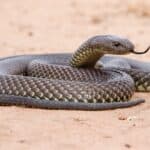
King brown snake
King brown snake Pseudechis australis
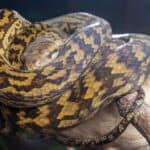
Scrub python
Scrub python Simalia amethistina

Related Species 7

Central bearded dragon
Central bearded dragon Pogona vitticeps Shared Family
Eastern bearded dragon Pogona barbata Shared Family
Eastern water dragon Intellagama lesueurii Shared Family
Gippsland water dragon Intellagama lesueurii howittii Shared Family
Gilbert's dragon Lophognathus gilberti Shared Family
Jacky dragon Amphibolurus muricatus Shared Family
Ambon sailfin lizard Hydrosaurus amboinensis Shared Family

Ecological Equivalents 4

Animals that fill a similar ecological role in their ecosystem

Central bearded dragon
Central bearded dragon Pogona vitticeps Occupies a similar Australian agamid niche as a diurnal, primarily insectivorous predator in open woodland and savanna. Both species use conspicuous threat displays and rapid sprinting to evade predators. General ecology is summarized in regional field guides and handbooks; note that Chlamydosaurus is more arboreal than Pogona.
Northern water dragon Lophognathus temporalis They have overlapping northern Australian distributions and habitat use, occupying woodlands and riparian edges; both are diurnal agamids that forage on arthropods and rely on display behaviors for defense and territoriality. This ecology is commonly reported in Australian herpetofauna references.
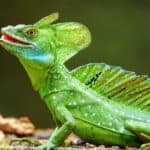
Basilisk lizards
Basilisk lizards Basiliscus spp. Functional analogue (not closely related; family Corytophanidae). Diurnal, arboreal/edge-habitat lizards known for rapid bipedal running and dramatic display structures and behaviors used in predator deterrence, paralleling the frill display and bipedal sprinting of Chlamydosaurus.
Gliding lizards Draco spp. Arboreal, insectivorous lizards that use expandable display membranes (patagia and dewlaps) for signaling. They have a comparable reliance on visual displays and tree-trunk habitat, although Draco occurs in Southeast Asian forests rather than Australia/New Guinea.

“Frilled lizards can stand up and run on their hind legs”

A frilled lizard also goes by the names frilled-neck lizard, frilled dragon, and frilled agama. It is known for raising its neck frill, or the extra flap of skin around its neck, in an effort to intimidate predators. These lizards live in northern Australia and New Guinea. Upon seeing the raised neck frill of this lizard, some people think it’s venomous or that it spits poison at predators. In reality, this reptile is not venomous and has no poison to spit!

5 Incredible Frilled Lizard Facts!

  • It’s sometimes called the bicycle lizard because of the way its hind legs move when it’s running
  • They are kept in some households as exotic pets that need special care
  • The female lays eggs up to 8 inches underground
  • Frilled dragons are not poisonous
  • They can live up to 20 years

Scientific Name

Chlamydosaurus kingii is the scientific name of the frilled-neck lizard. The Latin word chlamydo means small cloak while saurus means lizard. It’s also called the frilled dragon and the frilled agama. It belongs to the Agamidae family and the class of Reptilia.
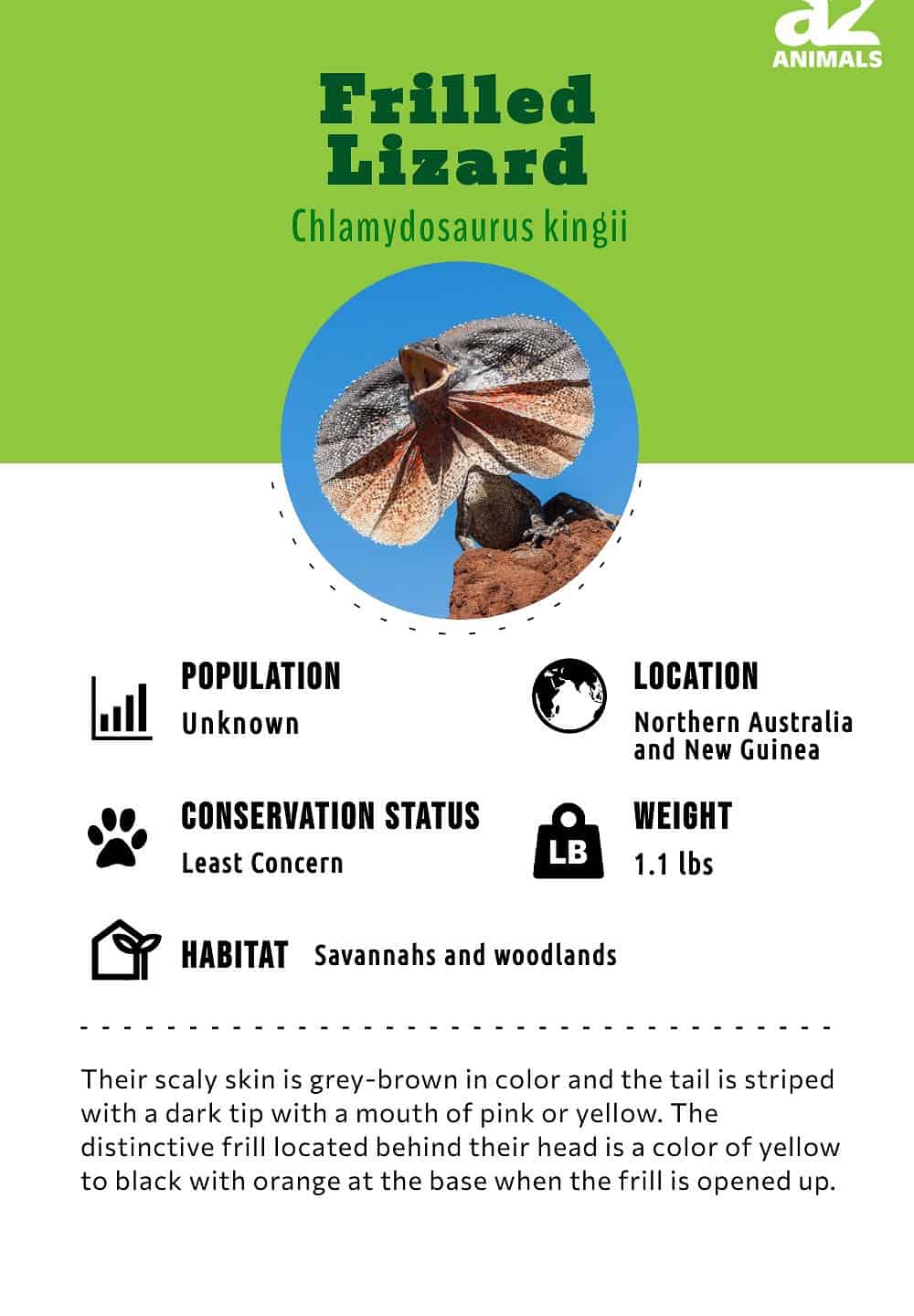
Evolution And Origin
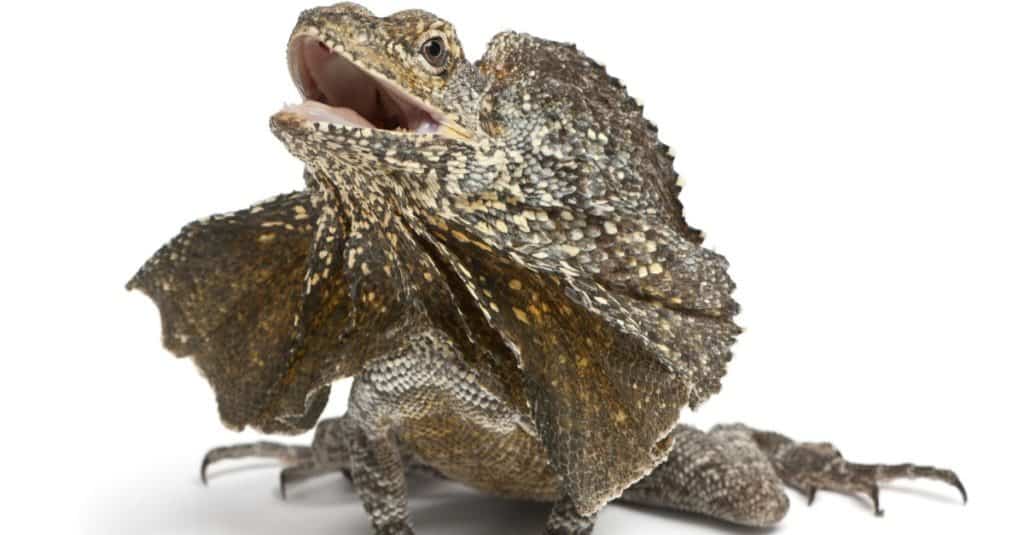
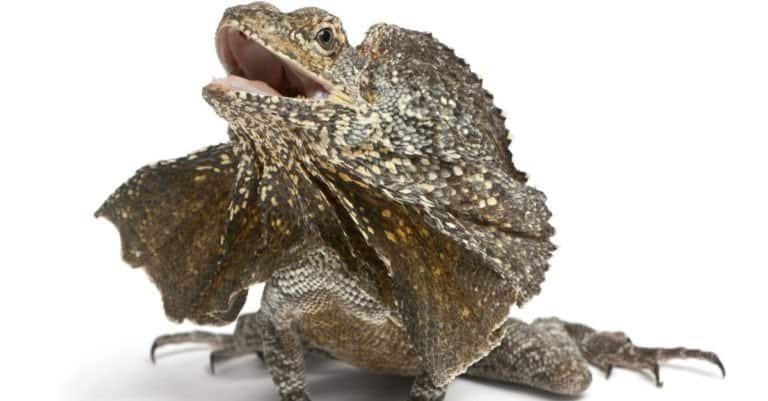
Frill-necked lizard, also known as the frilled lizard, Chlamydosaurus kingii, in front of white background

This reptile split from its closest living relative around 10 million years ago.

It is believed that the earliest reptiles evolved from a Sauropsida ancestor around 315 million years ago, during the Carboniferous period. One of the earliest indisputable reptile fossils was Hylonomus, an amniote lizardlike animal about 7.87 inches long. Not long after these first amniotes appeared, they diverged into three groups—anapsids, synapsids, and diapsids—during the late Paleozoic Era, 298.9 million to 252.2 million years ago.

The frilled lizard is believed to have been around for around 100 million years, although fossil evidence of a chisel-toothed lizard was found dating back 80 million years ago to the Cretaceous period. This lizard split from its closest living relative around 10 million years ago.

Types Of

While the frilled lizard is the only one of its kind in the genus Chlamydosaurus, there are 420 species in the same family (Agamidae) as the frilled lizard, also sometimes known as the family of chisel-toothed lizards. The frilled lizard is the only one of its kind that has this distinctive frill. Here are a few members of the Agamidae family:

Appearance And Behavior

Frilled lizard on termite mound

Frilled lizards weigh just over 1 pound

A frilled lizard has grayish-brown scales and is usually about 3 feet in length. Though it’s size is rather large, it only weighs just over one pound. Line up two and a half bowling pins and you’re looking at the length of a 3-foot frilled lizard. A frilled lizard that weighs a little over one pound is about equal in weight to a can of soup.

This reptile has a long tail and claws made for hanging onto the trunk of a tree to climb it quickly. The brown-gray scales of this lizard help to camouflage it in the trees.

The frilled dragon is solitary and remains alone most of the time except during breeding season.

Frilled Lizard’s Neck Frill
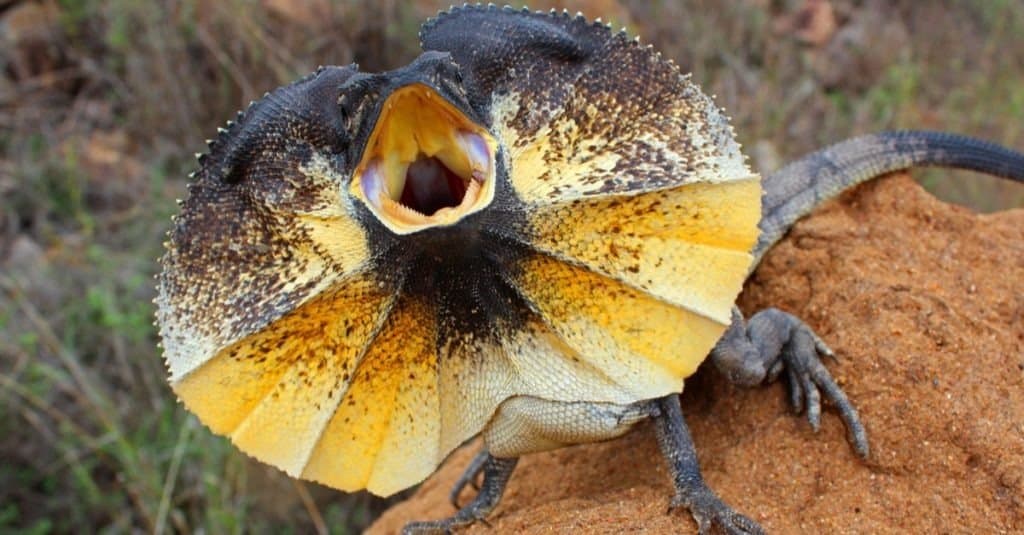
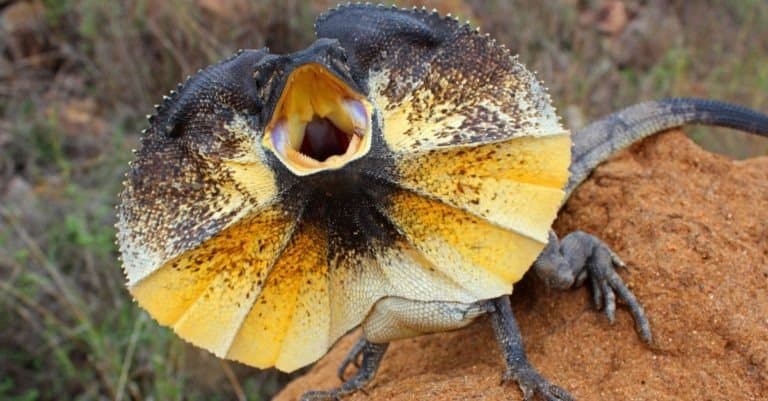
Frilled Lizard on a rock

Also called a neck frill, the fold of skin that encircles its throat is where this lizard gets its name.

This lizard gets its name from the fold of skin, also called a neck frill, that encircles its throat. Most of the time, this fold of skin lays flat like a superhero cape on the lizard’s body. However, when this reptile is threatened by a predator, it raises its neck frill, opens its mouth, and hisses. This makes the lizard look larger in size and threatening. In short, the animal does this in an effort to frighten a predator. Its neck frill measures about 12 inches in diameter. While frilled lizards might look frightening, they’re generally not dangerous and prefer to run away from threats rather than bite.

Raising its neck frill usually confuses a predator long enough for the lizard to start running on its hind legs toward a tree. It makes sense. A confused predator is very likely to let a frilled lizard get away! By the way, this reptile’s clumsy run is an incredible sight to see.

Habitat

The frilled lizard lives in northern Australia and New Guinea. This reptile lives in a warm environment. Its habitat includes woodland savannas as well as temperate and tropical forests.

These reptiles spend most of their time high up in the trees. Their dull, grayish-brown skin helps them to blend in with the tree trunks and branches. The scales on the neck frill of this lizard help to prevent loss of moisture in their warm environment. Frilled dragons are quick and can move up and around the trunks of trees in short bursts of speed.

These lizards don’t migrate. They are more active during the wet season (October to April) than they are during the dry season. Though they don’t go into traditional hibernation, they decrease running and other activities as well as eat less during the dry season.

Diet

These lizards are carnivores eating the food source that is most abundant in their tropical habitat.

What Eats Frilled Lizards?

Birds of prey such as eagles, owls and hawks, snakes, dingoes, larger lizards, and feral cats are predators of these lizards.

What Does A Frilled Lizard Eat?

Insects play a large role in the diet of the frilled agama aka the frilled lizard. Cicadas, spiders, beetles, ants, termites, moths, and butterflies are all on the menu. These reptiles also eat small mammals such as mice and rats. They’ve been known to eat smaller lizards as well.

When hunting for food, frilled dragons wait near a mouse’s hole or close to a dead tree where termites live. Then, when the animal appears, the lizard grabs it and won’t let it go. These lizards hunt for prey at sunrise and sunset.

This reptile has been known to consume hundreds of thousands of termites in one sitting, then not eat again for months. One termite colony may contain as many as 1 million termites and weigh up to 1,000 pounds. Picture a grand piano and you’re picturing an item that weighs 1,000 pounds.

Predators And Threats
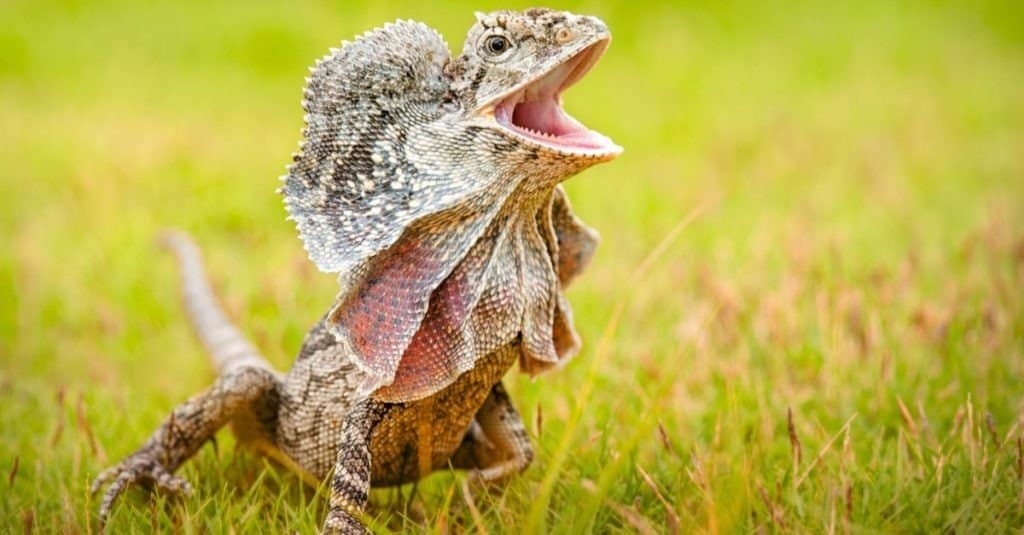
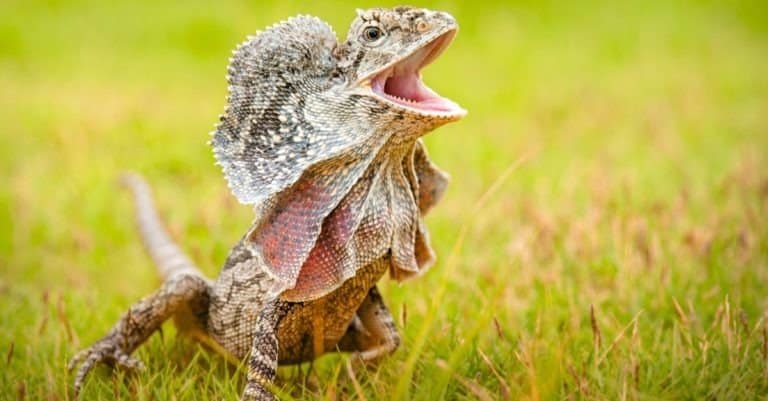
Frilled lizard in grass

The frilled dragon can look quite intimidating when it is seeking to scare away a predator.

Birds of prey, dingoes, snakes, feral cats, and larger lizards are all predators of these lizards. These lizards spend most of their time in trees.

As you see, many of its predators also have access to the trees making these lizards vulnerable. Their skin allows them to blend in with their leafy environment so they can sometimes hide. Plus, they are quick and may be able to outrun them. If a lizard climbs down to the ground in search of food, a dingo may capture it before it gets back into the relative safety of a tree.

The conservation status of the frilled agama is Least Concern. But it does face a few threats. Its habitat is threatened by deforestation. In addition, an increase in feral cats in their living environment has contributed to a decrease in their population.

There are no specific conservation plans in place for this lizard. However, there are some wildlife parks that are home to some of these lizards. Wasur National Park in New Guinea is one example.

Reproduction, Babies, And Lifespan
The breeding season of these lizards runs from September to October. The male lizards compete for females by fighting and displaying their neck frills. Also, a male bobs his head up and down to get a female’s attention. Female lizards lay their eggs between the months of November to February. The eggs are laid from 1 to 8 inches below ground. These lizards usually choose to dig the hole in a sunny area, so the sunlight gives some warmth to their eggs. A female lays from 8 to 14 soft-shelled eggs in one clutch. The incubation period of the eggs is 2 to 3 months. Each egg weighs less than an ounce in size. Some females have 2 clutches of eggs per season.

Baby lizards are able to survive without any care from their parents after they hatch. Each baby is about as long as an adult’s pinkie finger! And, yes, baby lizards have full use of their neck frill. They can eat small insects including ants and termites. Generally, a lizard stays with its brothers and sisters for about 10 days before leaving to establish its own life.

The lifespan of this lizard can go as high as 20 years! In fact, a 20-year-old frilled lizard living in captivity holds the record as the oldest of its kind.

These lizards can become ill due to a lack of vitamin D and calcium. This causes lethargy and a lack of appetite. Frilled lizards need a certain amount of ultraviolet light each day to receive vitamin D and absorb calcium to keep them in good health.

In Culture
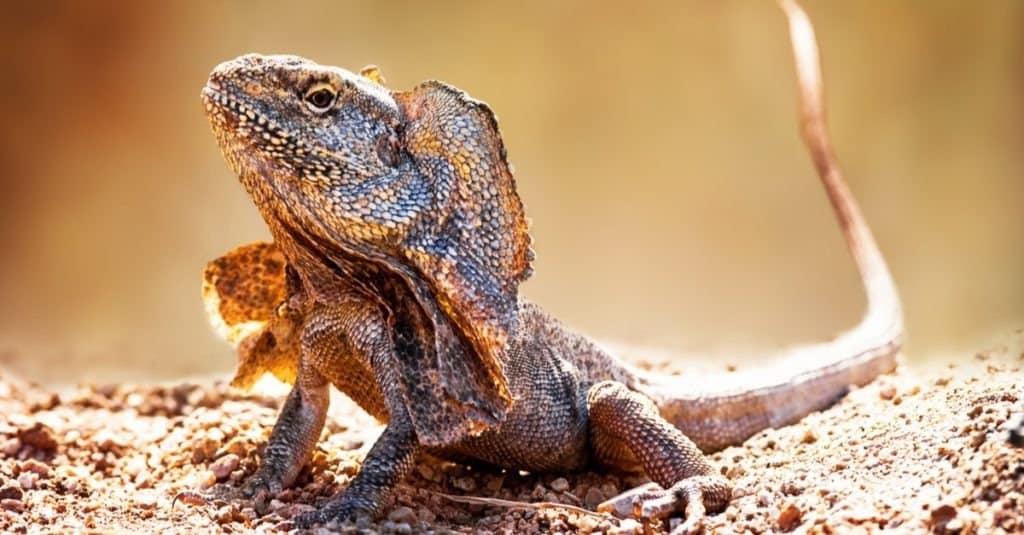
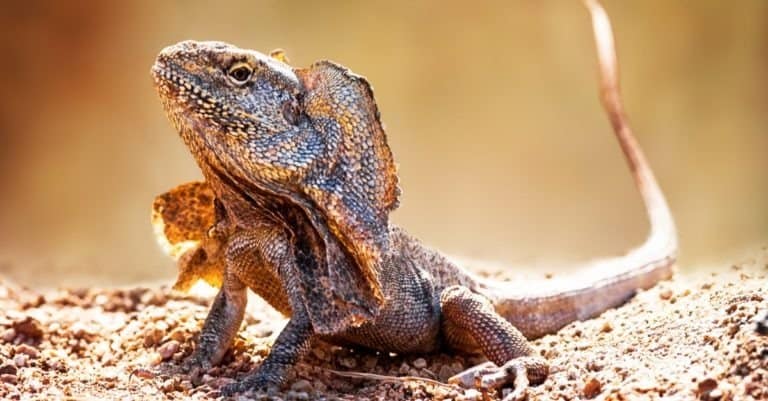
Closeup of alert frilled neck lizard (Chlamydosaurus kingii) on land

“Lizzie” was the mascot for the 2000 summer Paralympic Games.

A frilled neck lizard was featured on the reverse side of the Australian 2-cent coin until the early 90s. A frill-necked lizard named “Lizzie” was the mascot for the 2000 summer Paralympic games. Additionally, an anthropomorphic version of “Lizzie” reappeared as the mascot for the Australian team of the 2020 Paralympic games. The lizard features on the emblem of the Northern Australian regiment.

So, the frilled lizard has been seen throughout different countries and continues to be a part of Australian culture.

Population

According to the IUCN Red List of Threatened Species, the exact population of this reptile is unknown. This is because these lizards are quick to hide making it difficult to record an accurate count. However, their official conservation status is Least Concern.

Scientists think the population of this lizard is decreasing due to threats to its habitat and an increase in predators such as feral cats.

In the Zoo

View all 170 animals that start with F

Sources

  1. Wikipedia / Accessed February 5, 2021
  2. Animal Diversity Web / Accessed February 5, 2021
A-Z Animals Staff

About the Author

A-Z Animals Staff

AZ Animals is a growing team of animals experts, researchers, farmers, conservationists, writers, editors, and -- of course -- pet owners who have come together to help you better understand the animal kingdom and how we interact.
Connect:

Thank you for reading! Have some feedback for us?


Frilled Lizard FAQs (Frequently Asked Questions)

This reptile is a carnivore.